50 million MusselS Project
Mussels are a valuable component to maintaining water quality — they filter nutrients, toxins, and sediments.
Mussel populations in the Potomac have suffered greatly due in part to habitat loss and pollution, but we want to bring them back. We launched the 50 Million Mussel Project with the goal of rebuilding a once thriving native freshwater mussel population that will help improve water quality for all whole rely on the Potomac watershed.
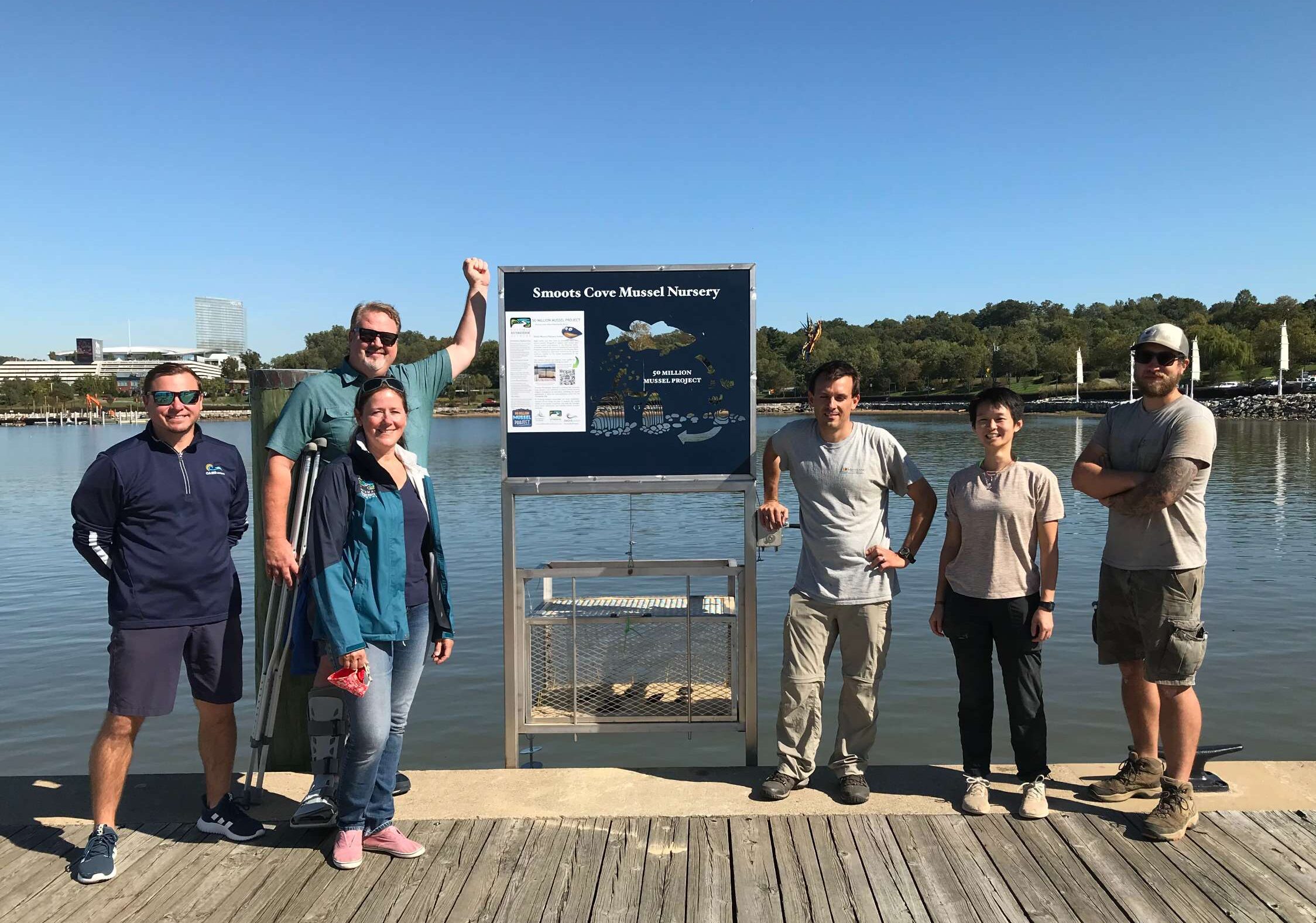
In 2019, Potomac Riverkeeper Network (PRKN) began a pilot project for the augmentation of mussels in the Potomac River. Working with Maryland Department of Natural Resources (DNR) and National Harbor, a mussel nursery was installed just adjacent to our floating lab housed on MV Sea Dog at National Harbor, Oxon Hill, MD. This project is part of PRKN’s ongoing efforts to heal the Potomac and the Bay, and to better understand the impacts of climate change and how native mussels help. Our early analyses indicate that this location in particular has reached a suitable environmental state for sustaining a vibrant wild mussel population as well as a floating wetland ecosystem.
All About Mussels
Freshwater mussels, like Eastern Lampmussel and Alewife floaters, are among 16 species native to the Potomac River and its Maryland tributaries, and once existed in the millions, similar to the oyster populations in the Chesapeake Bay. Like oysters, mussels are effective at removing nutrients and toxins, filtering out sediments and improving water quality. Scientific opinion is unanimous that mussel recovery is an important part of improving the water quality in the Chesapeake Bay; both Maryland and Virginia’s departments of environment have expanded their commitment to the recovery of mussel populations.
The primary threat to mussel survival is sediment from stormwater erosion upriver, which can smother the mussel beds, and causes turbid conditions that prevent sunlight penetration needed for underwater grasses that provide protection and food supply for host fish younglings — host fish are a critical part of the mussel life cycle. Climate change and increased urbanization contribute to extreme rain events that cause stormwater erosion of stream banks and the movement of surface pollutants into our waterways.
Suspending oysters in baskets above the river bottom has proved to increase their survival in the bay environs, as the baskets can be pulled up, brushed off, and re-submerged into the water column, preventing sediment buildup from suffocating the oysters — this same technique can be used to grow mussels for their first few years. As conditions improve, mussels will begin to self-propagate on the river bottom.
THE SCIENCE BARGE
PRKN is taking our 50 Million Mussels Project to the next level with the Science Barge located at National Harbor, MD. The Science Barge will serve as a centralized hub for community outreach, scientific research, and freshwater mussel restoration while bringing together researchers, river advocates, and community members.
When local youth and river enthusiasts visit the Science Barge, they will explore real life science through a hands-on interactive experience while also immersing themselves directly into the behind-the-scenes of our work.
The Science Barge will serve as the primary home for our 50 Million Mussels Project and will host multiple upwellers, modular cages, and baskets that will boost juvenile mussel survival and growth.
A juvenile mussel growing at National Harbor can become part of a restored mussel bed elsewhere in the watershed. Data collected by our scientists and volunteers can help us understand where restoration will have the greatest impact. A student visiting the barge can become a community scientist—or someday a scientist or Riverkeeper. And the lessons we learn here can help expand mussel restoration throughout the Potomac and Chesapeake Bay.
The Science Barge will also be the new home for our Tier III floating laboratory, Sea Dog – the heart of our Community Science Water Quality Monitoring program for the greater DC area. Relocating our floating lab vessel to the barge gives the program increased capacity as well as the potential to expand research to include other issues such as: microplastics, acidification due to climate change, and sea level rise.
By connecting education, science, and restoration within a single visible platform, this project will increase public awareness, foster community ownership, and build existing and new partnerships with local agencies and institutions through collaboration on research and mussel propagation that improve water quality and accelerate progress toward regional restoration goals.

The time to act is now – studies show the Potomac River has reached the point where it can once again support vibrant mussel populations. Building a thriving population of these small but mighty creatures is the critical next step towards improving (and maintaining) water quality in the Potomac.
FOLLOW THE 50 MILLION MUSSEL PROJECTwww.50millionmusselproject.com