Staff find levels of fecal bacteria in stream increase by at least two orders of magnitude as it passes through culvert; observe water actively dripping from ceiling of culvert underneath sewage-filled canal
In the time since DC Water began to fully divert sewage from the failed Potomac Interceptor through a day-lit portion of the C&O Canal, fecal bacteria sampling of a stream passing through a culvert underneath the impounded sewage suggests the possibility that sewage-contaminated water is actively discharging to the unnamed tributary of the Potomac River. The stream is the waterbody that conveyed more than 200 million gallons of raw sewage to the Potomac River during the first weeks of the Potomac Interceptor overflow. DC Water, federal, and state environmental regulators should urgently respond by investigating and abating the source of the contaminated discharge, as well as assess the bypass operation and integrity of the culvert.
Methodology
Over a two-week period, Potomac Riverkeeper Network (PRKN) staff sampled at four locations from an unnamed tributary that flows through a culvert located between Locks 11 and 10 of the C&O Canal. PRKN staff collected stream samples from just upstream of the culvert and below the Clara Barton Parkway; approximately 6 feet inside the culvert; directly below the culvert; and further downstream where the unnamed tributary meets the Potomac River. Samples were placed on ice immediately after retrieval and transported to the PRKN mobile laboratory, the SeaDog, at National Harbor, MD. The SeaDog is a Tier III Virginia and Maryland certified lab.
PRKN staff followed the IDEXX protocol for E.coli bacteria sampling and analysis. Each 100 mL field sample was diluted with Deionized Water to an appropriate level for the most accurate bacteria readings. The Above Culvert samples were diluted only on January 23 to a 1:10mL dilution and were not diluted for the following samples. The other samples were all diluted to a 1:100mL ratio. Once diluted, a packet of Colilert-18 was dissolved into each sample, followed by each sample being sealed into a Quantitray. These Quantitrays were placed in an incubator at 35℃ for 20 hours, as the Colilert-18 only needs an 18-hour incubation period. After the incubation period, positive E.coli cells were identified under a UV blacklight and used to calculate the Most Probable Number (MPN).
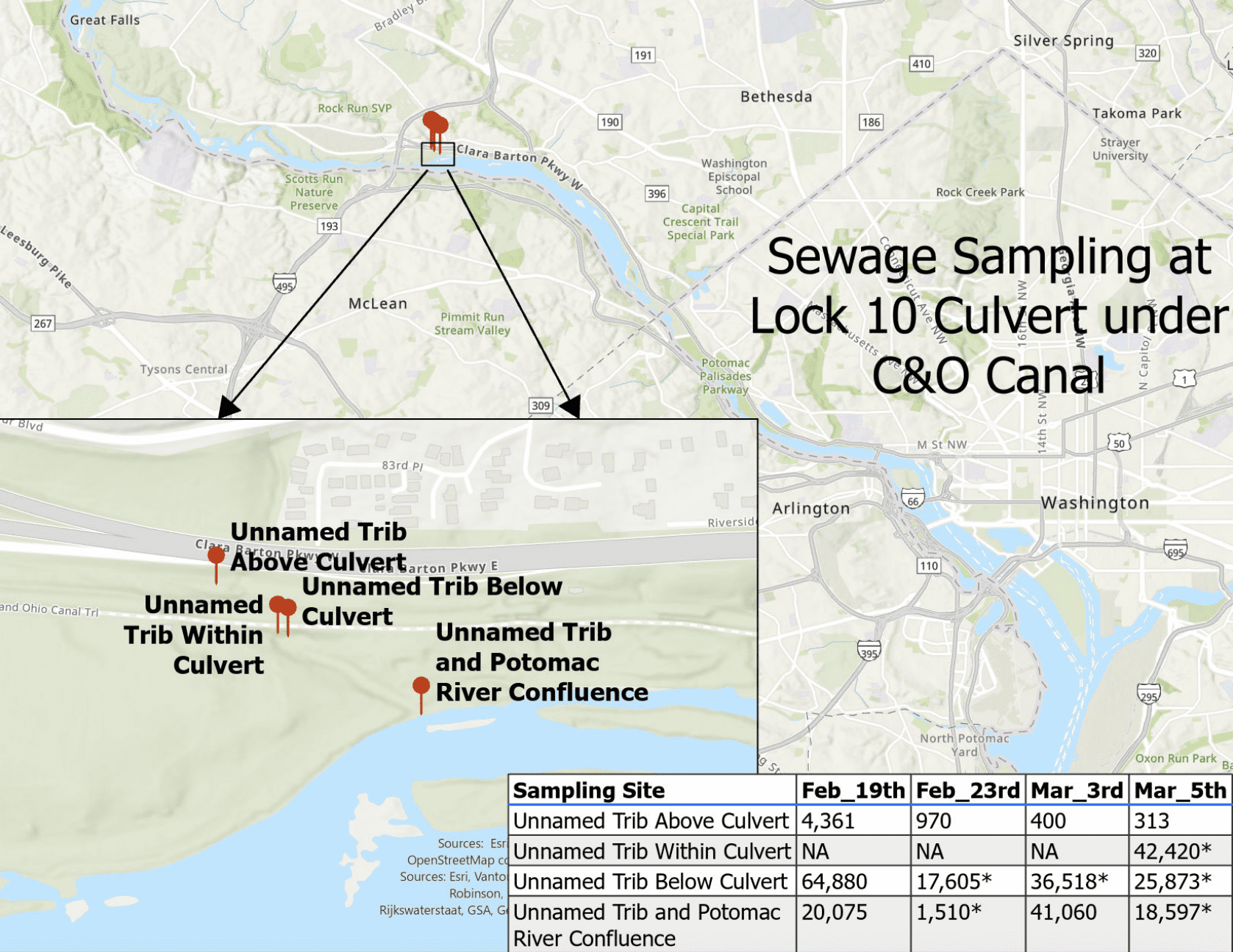
Figure 1 shows the sampling area where PRKN staff collected samples from the unnamed tributary near the Lock 10 C&O Canal culvert.
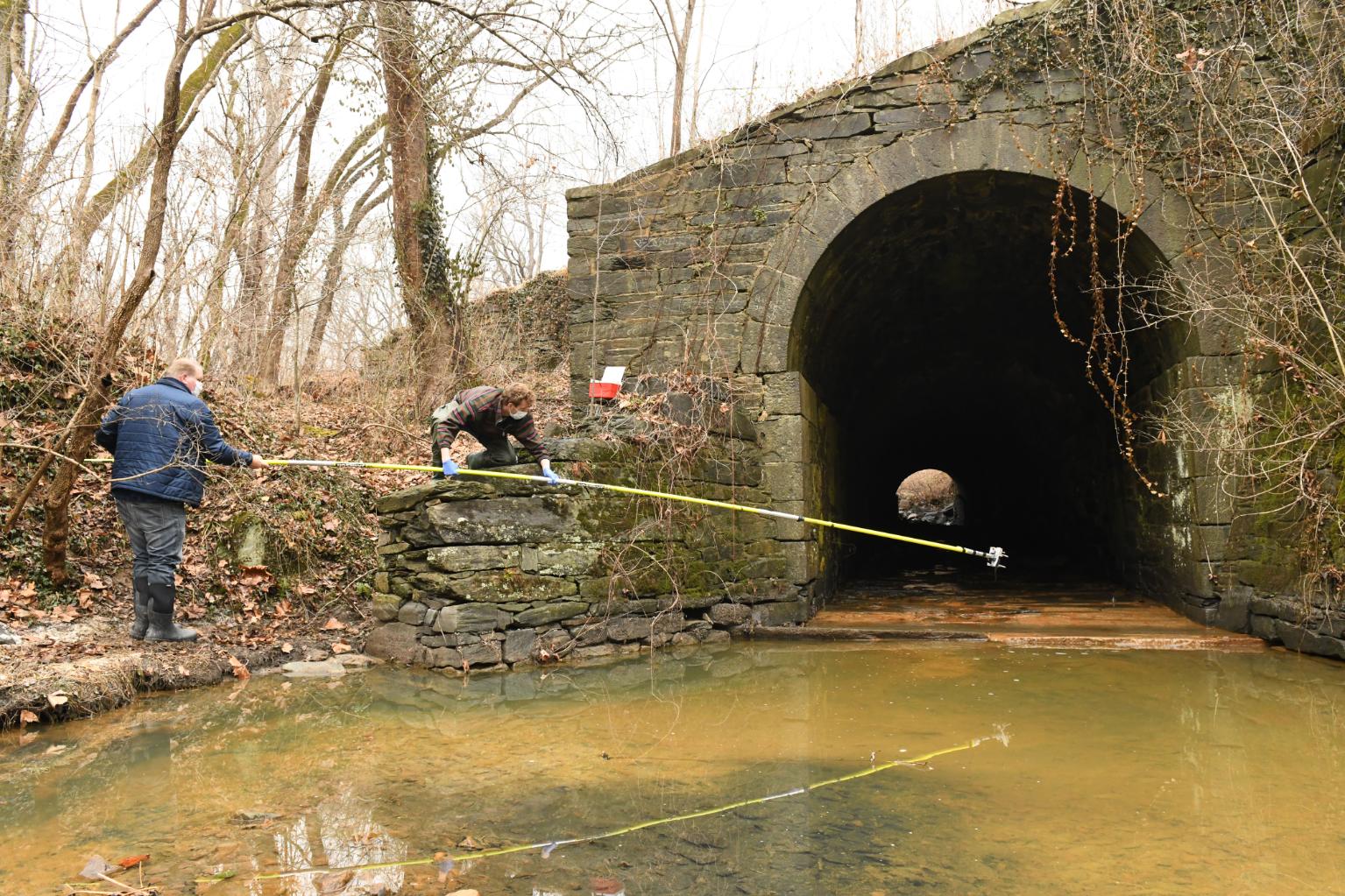
Photo Credit: Alan Lehman
| Feb. 19th,2026 | Feb. 23rd,2026 | Mar. 3rd,2026 | Mar. 5th,2026 | |
| Unnamed Trib Above Culvert | 4,361 | 970 | 400 | 313 |
| Unnamed Trib Within Culvert | NA | NA | NA | 42,420* |
| Unnamed Trib Below Culvert | 64,880 | 17,605* | 36,518* | 25,873* |
| Unnamed Trib and Potomac River Confluence | 20,075 | 1,510* | 41,060 | 18,597* |
Table 1 shows the E.coli bacteria levels, measured in Most Probable Number (MPN), from four sections along the unnamed tributary: above, within, and below the culvert, along with where the tributary meets the Potomac River. Bacteria levels with an * represent an average between two samples taken at the same location and time, while levels in red exceed the EPA water recreation safety limit of 410 MPN.
Discussion
The unnamed tributary flows through a stone masonry culvert that is directly underneath both the C&O canal – which is currently filled with bypassed sewage and settled solid waste – as well as the towpath. Above the culvert, the rust-colored tributary slowly flows through the floodplain of bleached soil and toilet paper leftover from the first weeks of the Potomac Interceptor sewage spill. Here, E. coli bacteria levels have steadily dropped over the past two weeks, where they are now within the EPA safety limit of 410 MPN.
Inside the culvert, there is clear evidence of dripping from the ceiling. At each of the four sampling events, PRKN staff observed continuous dripping from an estimated 20-30 visible locations within the culvert. The dripping is often loud enough to echo throughout the tunnel. The tunnel dripping was evident during both wet- and dry weather conditions.
This is directly under the C&O Canal, where everyday millions of gallons of raw sewage flow through and layers of solid sewage waste accumulate within the canal. The culvert’s stone floor appears to be bare stone free of substantial residual waste. On March 5, PRKN staff collected three samples at the left, center, and right sides towards the end of the culvert; the average of these three samples was 42,420 MPN, the highest reading from that sampling day.
After exiting the culvert, the tributary flows along a streambed covered in orange microbes, fungus filaments, and dark-colored pockets of sludge. The pungent odor is also much stronger at the culvert’s opening below as compared to above the culvert. E.coli levels below the culvert are consistently 1 to 2 magnitudes higher than the above culvert samples. The tributary continues to flow downstream until it enters the Potomac River where bacteria levels are always above the EPA safety limit.
Conclusion
Based on this evidence, fecal bacteria-contaminated water may be leaking out of the culvert from directly underneath the impounded raw sewage within the Canal located above it and polluting the tributary below. The continuing discharge of fecal bacteria – not including other dangerous pathogens, toxics, nutrients, and other environmental risks associated with raw sewage – is contributing to continuing contamination at unsafe levels in the Potomac River.
PRKN’s findings raise questions about the structural integrity of the culvert, given the active passthrough of water, as well as the ability of the bypass operation to effectively contain and prevent further pollution of the Potomac and environment. It also raises the prospect that planned remediation of the stream may fail if the source and extent of the potential contaminated discharges at the culvert are not first controlled. DC Water and state and federal agencies must respond to monitor the fecal bacteria and other pollutants discharging from the masonry culvert; investigate the source of the contaminated discharge; assess the integrity of the bypass operation and culvert; and abate the polluted discharge as soon as practicable.