Potomac Interceptor Sewage Spill Data & Updates
A Brief overview
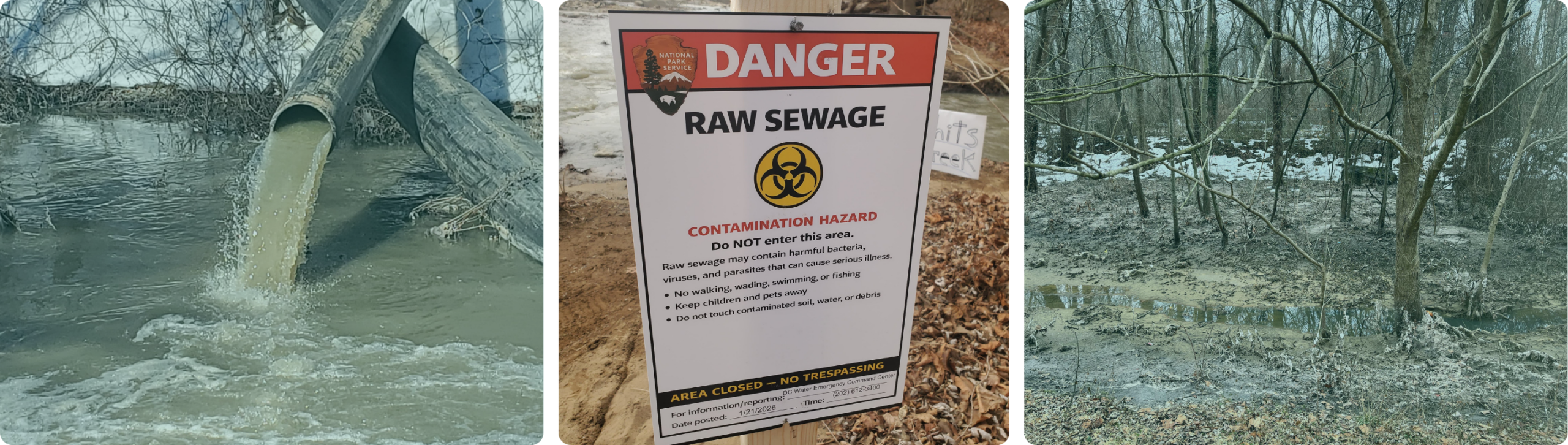
On January 19, 2026, a 6-foot wide interceptor pipe, owned and operated by DC Water, collapsed in Montgomery County, MD, releasing an estimated 243 million gallons of untreated sewage directly into the Potomac River. This sewage spill has been marked as one of the worst, if not the worst, sewage spills in U.S. history. Not only has this event created an on-going regional public health and environmental emergency, but it’s threatened our community’s dependence on the river – for recreation, for subsistence, and for livelihoods.
Potomac Riverkeeper Network (PRKN) has been, and will continue to, conduct independent water‑quality monitoring, provide transparent public updates, advocate for strong public‑health protections and accountability, and push for long‑term ecosystem restoration. Clean water is a public trust — and protecting the Potomac cannot wait. NOTE: DC Water has stated that drinking water has not been affected as water intake locations are above the sewage spill site.
FOLLOW these socials for the most up to date information!
The President’s Statement
On February 22nd, 2026, Potomac Riverkeeper Network (PRKN) President, Betsy Nicholas, shared a statement recounting events and developments so far, and now brings focus to PRKN’s vision for accountability and remediation efforts in the near future.
READ BETSY’S STATEMENT HERE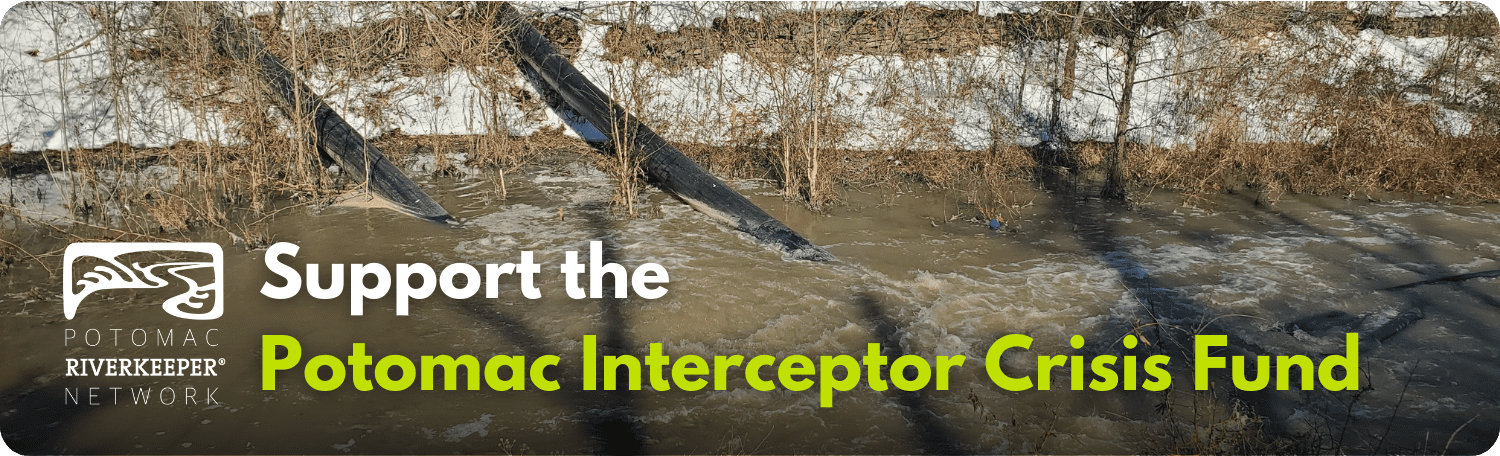
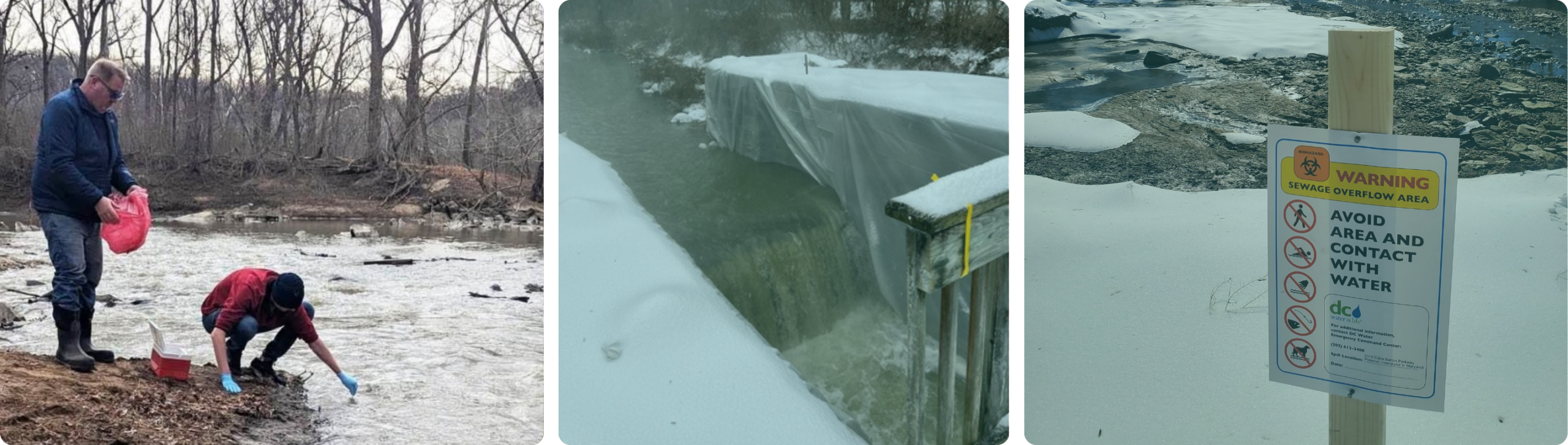
Since the very beginning, Potomac Riverkeeper Staff and volunteers have been on the ground investigating, documenting, and collecting water quality samples at the sewer spill and miles downriver. In the coming weeks and months, we will continue this effort to detect ongoing pollution, document ecological conditions, and provide reliable water quality data to policymakers and the public – but we need your support.
Timeline of events
| DATE | EVENT |
|---|---|
| 1/19/2026 | DC Water’s Potomac Interceptor pipe breaks |
| 1/21/2026 | PRKN makes first site visit |
| 1/23/2026 | PRKN conducts first water sampling; results show E. coli levels 12,000 times safe levels |
| 1/24/2026 | DC Water begins partial containment in C&O canal, but sewage overflows continue |
| 1/24/2026 | Prince George’s County, MD issues a public health advisory |
| 1/25/2026 | Charles County, MD announces Potomac River closure notice |
| 1/27/2026 | Maryland Department of the Environment issues a shellfish advisory 70 miles downriver from the spill site |
| 1/28/2026 | PRKN expands water quality testing in partnership with the University of Maryland (UMD) |
| 1/29/2026 | DC Water declares “full containment” |
| 1/29/2026 | Montgomery County, MD issues a public health advisory |
| 2/10/2026 | DC Water acknowledges a major sewage release of roughly 600,000 gallons |
| 2/11/2026 | PRKN holds a webinar covering the spill and publishes an action alert demanding local governments to take action |
| 2/12/2026 | DC Department of Energy and Environment (DC DOEE) publishes a recreational advisory |
| 2/13/2026 | Virginia Department of Health publishes recreational advisory for 72.5 miles |
| 2/17/2026 | Virginia Department of Environmental Quality conducts bacteria testing along 49 miles of river from Chain Bridge down to Potomac Creek in Stafford County |
| 2/18/2026 | DC Mayor Bowser issues a state of emergency |
| 2/20/2026 | PRKN testifies at the DC DOEE oversight hearing |
Water sampling data (Updated 2/25/2026)
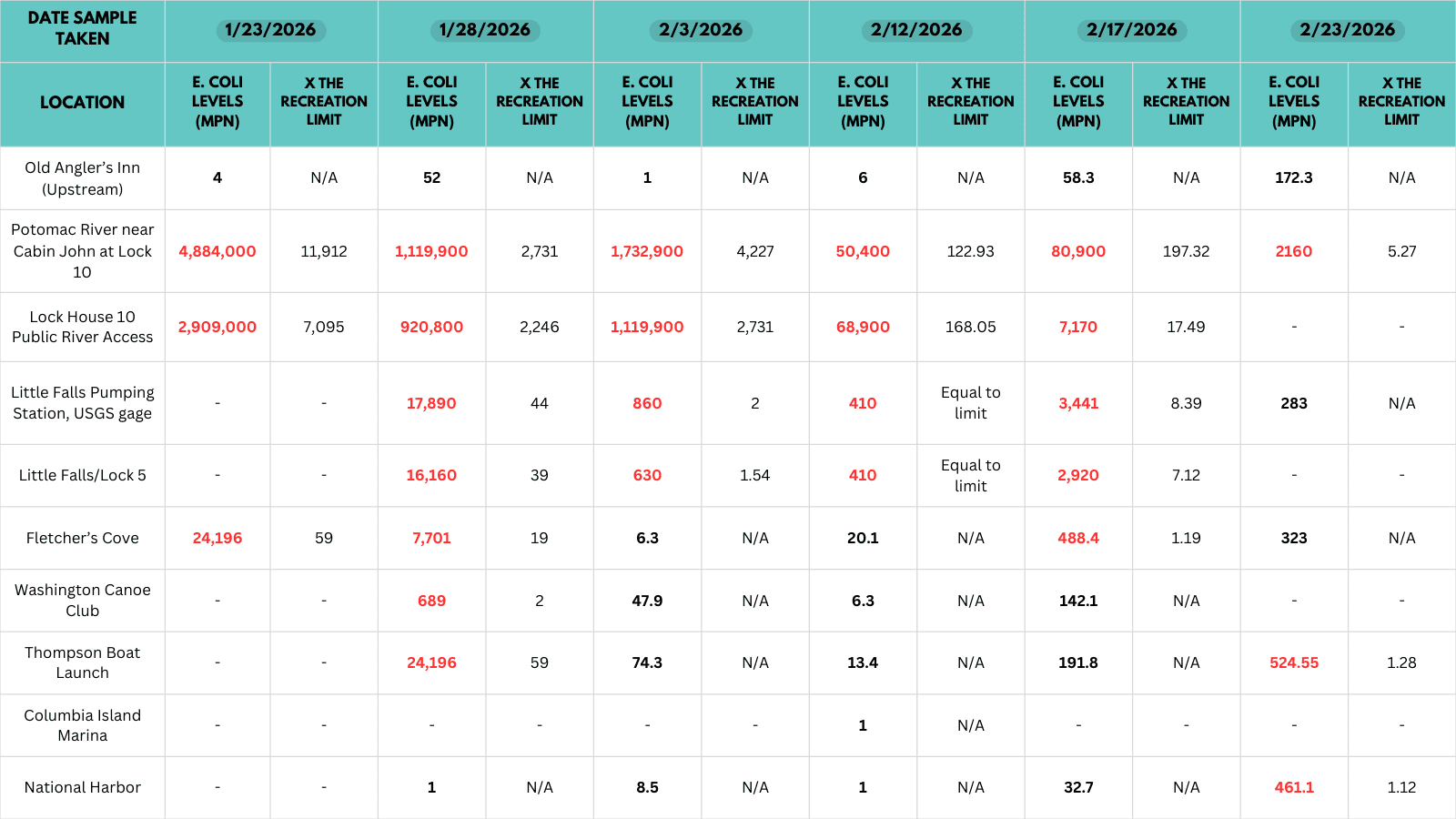
Red numbers indicate failing test results. A “-” indicates that the sample site was not tested on that particular date. The data taken on January 28, 2026 and after were done in partnership with the University of Maryland.
CLICK FOR LARGER IMAGE.
In partnership with the University of Maryland, PRKN is conducting weekly water quality monitoring testing at various locations to assess and report on the E. coli levels over time. These results act as an indicator for when and where contact with the water might not be safe. E. coli levels are considered “safe” when levels fall below the 410 MPN/100 mL threshold established by the EPA. In this case, it may also serve as an indicator for sewage overflows if a spike in levels is observed.
With the estimated timeline for repair of the broken interceptor pipe exceeding multiple months, it is critical that regular water quality monitoring continues now and throughout the summer.
Interactive Data Map
This interactive ArcGIS map compiles all of our water quality data to date and is a great visualizer to understand bacteria levels at testing sites nearest you.
RECENT Press Releases
Contamination From Spill Remains High, Says Potomac Riverkeeper Network
Spanish translation available: Versión en Español Results from February 12 and February…
Press Release DC Sewer Spill Monitoring
Spanish translation available: Versión en Español POTOMAC RIVERKEEPER NETWORK CALLS FOR URGENT…
SAMPLING DATA ON SEWAGE SPILL RELEASED BY POTOMAC RIVERKEEPER NETWORK
Results Show Catastrophic Impact on Health of the Potomac Washington, DC –…
Partial Photo Credits to Burton Gray
Take Action
Your voice moves regulators and elected officials. Sign up for alerts, report pollution, and help us ensure every community has protections from legacy coal ash.