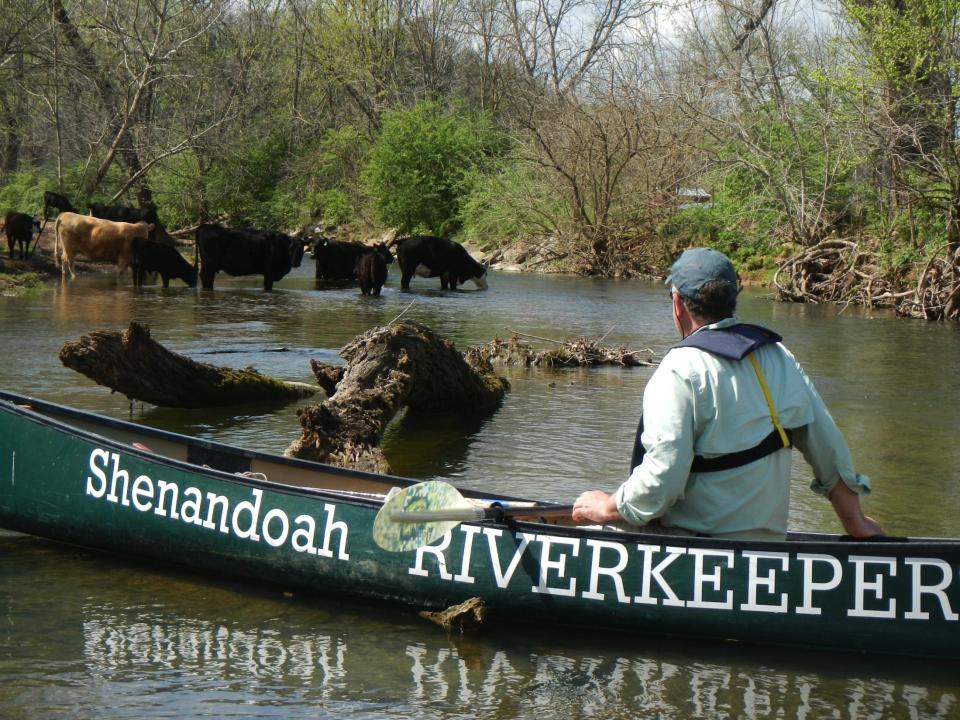
A major cause of pollution in the Shenandoah River is cattle manure. While many farmers are putting up fences and creating stream buffers to protect the river. Others permit their cattle herds unfettered access to the river and its tributaries. Unfortunately, cattle aren’t fastidious about where they defecate. What’s more, as they climb up and down the banks, they cause a great deal of erosion, and that sediment easily makes its way into the water.
To overestimate the impact of this situation is not possible. The sediment clouds the river and diminishes the ability of aquatic life to survive. Algal outbreaks, now all too common, foul the river to the detriment of recreation; even more important, that algae is thought to be a principal cause of the fish kills from which the Shenandoah and its tributaries suffer periodically.
Shenandoah Riverkeeper has worked for years to address the problem. But it is a challenge. Farmers are key supporters, but they are also business owners, and the cost of fencing the cattle is not trivial. Thus, the effort to demonstrate the benefits of cattle exclusion is often a delicate dance. Still, there have been successes — farm by farm. When Shenandoah Riverkeeper first started this effort, over 75 cattle herds had direct access to the North Fork, South Fork or the Main Stem of the Shenandoah River. Now, as a result of the Shenandoah Riverkeeper’s work, that number has been lowered to approximately 15 herds. And while this is significant, studies by Shenandoah Riverkeeper, the Environmental Integrity Project, and Virginia’s Department of Conservation and Recreation have shown that there are sections of the watershed where the majority of the cattle still have access to and defecate in the water and trample the banks.
In 2020, Mark and a coalition of like-minded advocates hit a home run when they persuaded the Commonwealth’s legislature, with support from Gov. Ralph Northam, to pass a bill which mandated fencing to exclude cattle across the state by 2025 and, more important for the farmers, a method by which funding would be provided to achieve the goal.
The impact of the Covid-19 pandemic will be long-lasting, and we do not know how deeply state revenues will be harmed. As a result, the necessary funding for cattle exclusion is by no means assured. Everyone who comes in contact with the Shenandoah watershed, whether the occasional user, an avid frequent angler or paddler, or someone who relies on the river for drinking water or employment, has a stake in this effort. We urge everyone to speak frequently and effectively — at town halls, among friends, and at the voting booth — to be sure that the progress we have made working together continues.
The Respect the Shenandoah Campaign is built on the recognition that we are all responsible for protecting our rivers so that others may use and enjoy them. We all use and enjoy the river. Working together, we can all Respect the Shenandoah and protect it as well.
Our History
Potomac Riverkeeper, Inc. was founded in 2000 by a group of local community members who saw the need for stronger enforcement of federal, state, and local clean water protections in local rivers through grassroots advocacy and legal action. Riverkeepers are the eyes and ears of the rivers, the voice of the rivers, and the experts in the rivers, protecting the public’s rights to clean water. Encompassing the skills of scientists, teachers, law officers, fishermen, and paddlers, Riverkeepers combine a profound knowledge of their waterway, matched with a relentless commitment to protecting clean water and the rule of law.
Ed Merrifield was hired in 2003 as the first Potomac Riverkeeper and President of the Potomac Riverkeeper Network. In 2006, Jeff Kelble was hired as the Shenandoah Riverkeeper, and in 2010 Brent Walls joined the team as Upper Potomac Riverkeeper. Ed Merrifield led the foundation in its early stages to their first successes including filing the first enforcement actions against polluters and testifying before Congress on the intersex fish problem that was plaguing the Potomac River in 2006. Ed retired from being President at the end of 2012, and in 2014 Jeff transitioned to be President and Riverkeeper.
In 2015, Potomac Riverkeeper Network was formed when the organization hired two new Riverkeepers: Mark Frondorf, Shenandoah Riverkeeper, and Dean Naujoks, Potomac Riverkeeper as well as Phillip Musegaas, Vice President of Programs and Litigation, to oversee its expanding docket of legal actions. The resulting organization, PRKN, is the sole nonprofit combining assessment, advocacy, legal action, and community engagement to stop pollution in the Potomac and Shenandoah Rivers.
After several more years of growth and success defending clean water in the Potomac and Shenandoah Rivers and their tributaries, Jeff left Potomac Riverkeeper Network, and in 2018 Nancy Stoner, one of the nation’s most experienced water policy experts, joined the organization as the new president, and, along with the board of directors, has helped PRKN expand and deepen its reach throughout the watershed.