Spanish translation available: Versión en Español
POTOMAC RIVERKEEPER NETWORK CALLS FOR URGENT RESPONSE BY AUTHORITIES TO RAW SEWAGE SPILL
Data From Group and University of Maryland Researchers Shows River Still Contains High Levels of Fecal Bacteria and Staph Pathogens
Washington, DC – February 5 – Investigation by Potomac Riverkeeper Network (PRKN) and researchers at the University of Maryland (UMD) found high levels of fecal-related bacteria and disease-causing pathogens in the Potomac River, which raise urgent public health concerns and underscore the risks posed by aging sewer infrastructure, PRKN President Betsy Nicholas and UMD announced today.
Nicholas said, “Raw sewage from a 60-year-old pipe has vomited roughly 300 million gallons into the Potomac River and is still not fully contained. Water testing collected nine days after the start of the disaster by PRKN and University of Maryland scientists still shows fecal bacteria levels more than 2,700 times the safe limit established by Maryland and Virginia. We are long past the time for DC authorities to issue a public health warning for recreational use. People want to know if the river is safe. Right now, the Potomac River is not safe!”
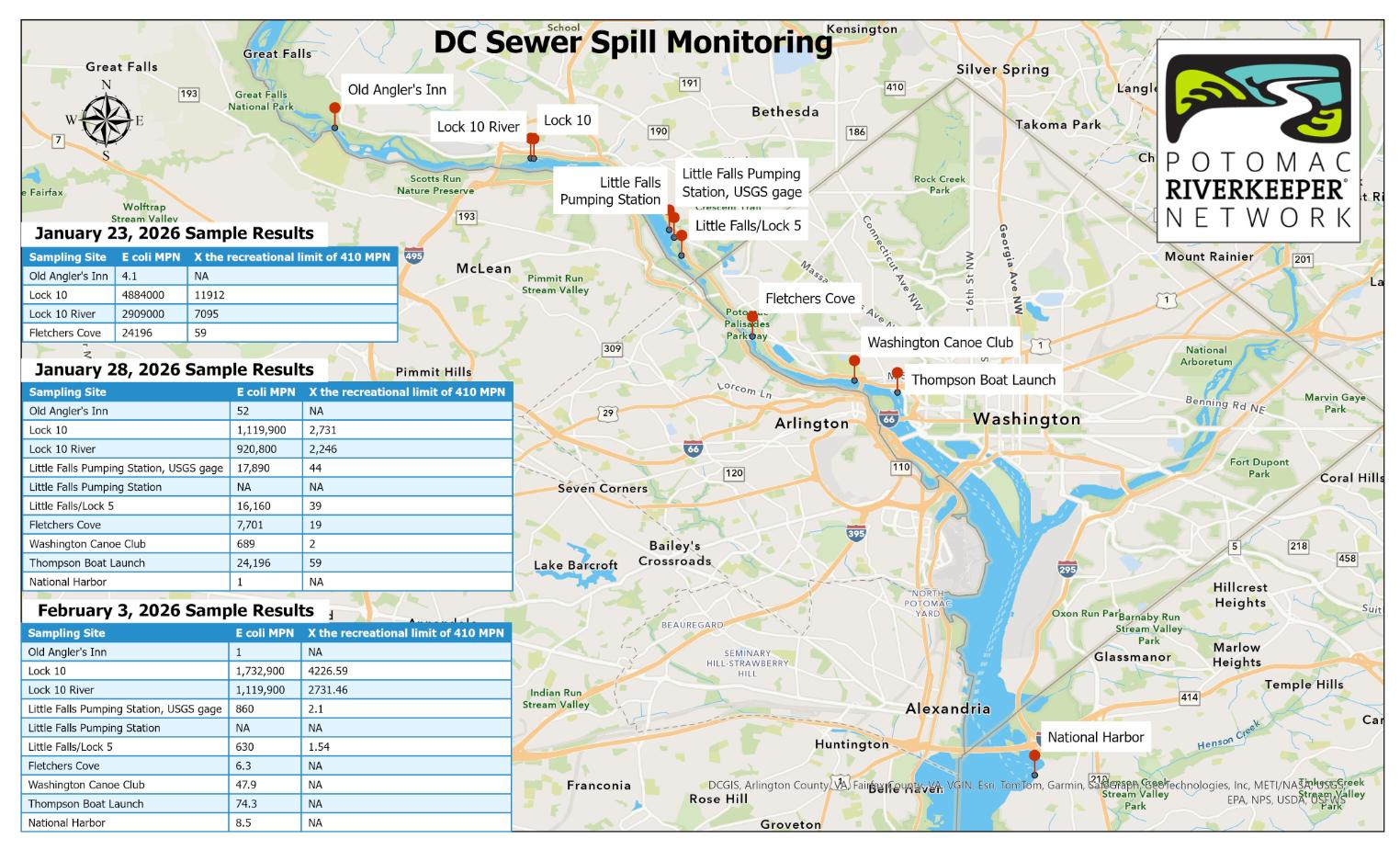
Dean Naujoks, Potomac Riverkeeper, said: “On January 28, staff from Potomac Riverkeeper Network and UMD researchers sampled nine sites across the Potomac River; the results showed that E. coli bacteria are still at incredibly dangerous levels, with the Lock 10 sewage effluent being 2,731 times beyond the MD and VA water safety limit (410 MPN/100 mL). High E. coli contamination continued all the way down to Thompson Boat House along the DC waterfront, about 10 miles downstream, with values ranging from 2 to 59 times above the recreational safety limit.”
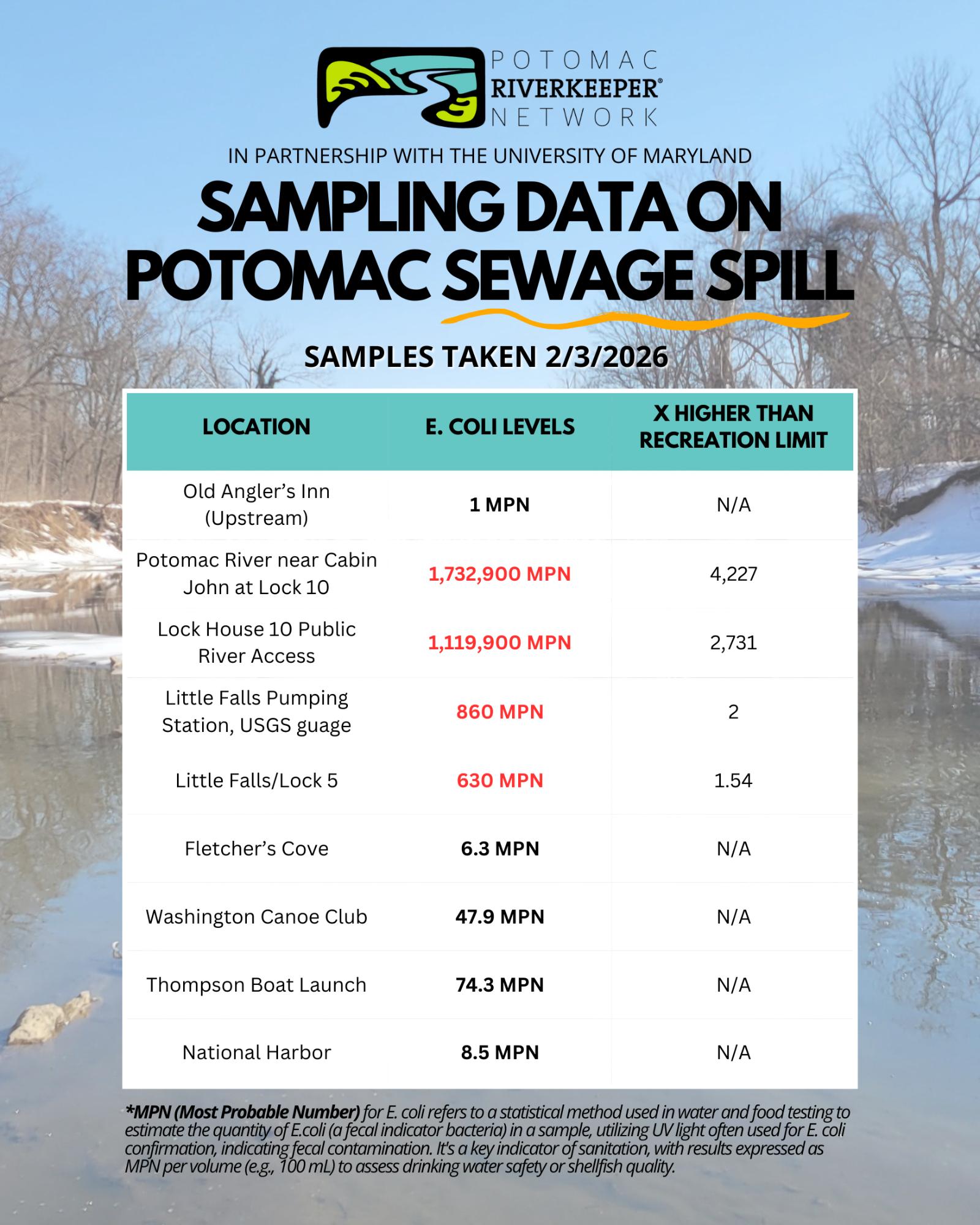
The results of February 3 sampling by PRKN and UMD show the sewage contamination continues to leak into the Potomac, with E. coli bacteria levels 4,227 times above the safety limit – this is a greater level than the January 28 testing. Bacteria levels remained above the safety limit 3.6 miles downstream towards Lock 5 and Little Falls.
CLICK FOR LARGER IMAGE
“DC Water claimed last week that the sewage leak was fully contained in the C&O Canal but on February 4, it acknowledged that ‘overflow risks remain,’ which ‘have resulted in slight increases in coliform levels near Lock 10 over the past two days.’ Our February 3 data show that the actual E. coli contamination is in fact 4,227 times over the safety limit – this is hardly ‘slight,’” said Naujoks.
Preliminary modelling data from the Maryland Department of the Environment showed the sewage contamination is likely impacting water quality more than 30 miles downriver all the way down to Quantico Creek. The State of Maryland issued a shellfish harvesting closure more than 50 miles downriver from the spill site, which highlights the incredible devastation this sewage spill has already inflicted on downstream communities that depend on the Potomac River. But to date, neither DC, Maryland, nor Virginia has issued any recreational use advisory.
CLICK FOR LARGER IMAGE
Naujoks continued, “We are getting messages and calls every day asking if the river is safe. People are fishing. There are currently two polar bear plunges planned downriver. And we are alarmed that UMD researchers found both Staphylococcus aureus (the bacteria behind Staph infections) and MRSA (an antibiotic-resistant strain of S. aureus) at the Lock 10 effluent site, which continues to flow straight into the Potomac River. Further downstream, S. aureus was found at a third of the sampling sites; this potentially dangerous bacterium is moving downstream. This discovery even more urgently requires a public health advisory from DC and Maryland officials – they must inform the residents about the grave risks to public health from this sewage spill.”
Nicholas concluded, “At a time when faith in our leaders is dishearteningly low, the wholly insufficient response by the DC government at all levels only adds to that loss of faith. Our conscience should be shocked when we remember that what is at risk here is public health – for millions of area residents.”
# # #
About Potomac Riverkeeper Network
Potomac Riverkeeper Network is a registered 501(c)(3) non-profit organization with three regional Waterkeeper branches: Potomac Riverkeeper, Upper Potomac Riverkeeper, and Shenandoah Riverkeeper. PRKN’s mission is to protect the right to clean water for all communities and all those who live in and rely upon the Potomac and Shenandoah watersheds by stopping pollution, making drinking water safe, protecting healthy river habitats, and enhancing use and enjoyment for all.
POTOMAC RIVERKEEPER NETWORK PIDE UNA RESPUESTA URGENTE DE LAS AUTORIDADES ANTE EL DERRAME DE AGUAS NEGRAS CONTAMINADAS
Datos del Grupo y de Investigadores de la Universidad de Maryland Muestran que el Río Aún Contiene Altos Niveles de Bacterias Fecales y Patógenos de Estafilococos
Washington, DC – 5 de febrero – Una investigación realizada por Potomac Riverkeeper Network (PRKN) e investigadores de la Universidad de Maryland (UMD) encontró altos niveles de bacterias relacionadas con contaminación fecal y patógenos que causan enfermedades en el río Potomac, lo que plantea preocupaciones urgentes de salud pública y subraya los riesgos que representa la infraestructura de alcantarillado obsoleta, anunciaron hoy Betsy Nicholas, Presidenta de PRKN, y UMD.
Nicholas dijo: “Las aguas negras contaminadas de una tubería de 60 años han derramado aproximadamente 300 millones de galones en el río Potomac y aún no están completamente contenidas. Las pruebas de agua recogidas nueve días después del inicio del desastre por científicos de PRKN y de la Universidad de Maryland todavía muestran niveles de bacterias fecales más de 2.700 veces el límite seguro establecido por Maryland y Virginia. Hace mucho tiempo que las autoridades de DC deberían haber emitido una advertencia de salud pública para el uso recreativo. La gente quiere saber si el río es seguro. ¡Ahora mismo, el río Potomac NO ES SEGURO!”
Dean Naujoks, Guardianes del Río Potomac (Potomac Riverkeeper), dijo: “El 28 de enero, el personal de Potomac Riverkeeper Network e investigadores de UMD tomaron muestras en nueve sitios a lo largo del río Potomac; los resultados mostraron que las bacterias E. coli todavía se encuentran en niveles increíblemente peligrosos, con el punto de derrame de aguas negras contaminadas de Lock 10 estando 2,731 veces por encima del límite de seguridad del agua de MD y VA (410 MPN/100 mL). La alta contaminación por E. coli continuó hasta Thompson Boat House a lo largo de la costa de DC, a unas 10 millas río abajo, con valores que oscilan entre 2 y 59 veces por encima del límite de seguridad recreativo”.
Los resultados del muestreo del 3 de febrero realizado por PRKN y UMD muestran que la contaminación por aguas negras contaminadas sigue filtrándose en el Potomac, con niveles de bacterias E. coli 4,227 veces por encima del límite de seguridad, un nivel superior al de las pruebas del 28 de enero. Los niveles de bacterias se mantuvieron por encima del límite de seguridad 3.6 millas río abajo hacia Lock 5 y Little Falls.
HAGA CLIC PARA UNA IMAGEN MÁS GRANDE
“DC Water afirmó la semana pasada que la fuga de aguas negras contaminadas estaba totalmente contenida en el Canal C&O, pero el 4 de febrero, reconoció que ‘persisten los riesgos de desbordamiento’, lo que ‘ha resultado en ligeros aumentos en los niveles de concentración de bacterias cerca de Lock 10 durante los últimos dos días’. Nuestros datos del 3 de febrero muestran que la contaminación real por E. coli es de hecho 4,227 veces superior al límite de seguridad, esto de ninguna manera es ‘ligero’” [como dice DC Water], dijo Naujoks.
Datos preliminares de proyección del Departamento de Medio Ambiente de Maryland mostraron que la contaminación por aguas negras contaminadas probablemente esté afectando la calidad del agua a más de 30 millas río abajo hasta Quantico Creek. El Estado de Maryland emitió un cierre de cosecha de mariscos a más de 50 millas río abajo del sitio del derrame, lo que resalta la increíble devastación que este derrame de aguas negras contaminadas ya ha infligido a las comunidades río abajo que dependen del río Potomac. Pero hasta la fecha, ni DC, ni Maryland, ni Virginia han emitido ninguna advertencia de uso recreativo.
HAGA CLIC PARA UNA IMAGEN MÁS GRANDE
Naujoks continuó: “Recibimos mensajes y llamadas todos los días preguntando si el río es seguro. La gente está pescando. Actualmente hay dos eventos de inmersiones planeadas río abajo. Y estamos alarmados de que investigadores de UMD encontraron tanto Staphylococcus aureus (la bacteria detrás de las infecciones por estafilococos) como MRSA (una cepa de S. aureus resistente a los antibióticos) en el sitio de derrame del Lock 10, que continúa fluyendo directamente hacia el río Potomac. Más abajo, se encontró S. aureus en un tercio de los sitios de muestreo; esta bacteria potencialmente peligrosa se está moviendo río abajo. Este descubrimiento requiere de forma aún más urgente un aviso de salud pública por parte de los funcionarios de DC y Maryland: deben informar a los residentes sobre los graves riesgos para la salud pública de este derrame de aguas residuales”.
Nicholas concluyó: “En un momento en que la fe en nuestros líderes es desalentadoramente baja, la respuesta totalmente insuficiente del gobierno de DC en todos los niveles solo se suma a esa pérdida de fe. Nuestra conciencia debería alarmarse cuando recordamos que lo que está en riesgo aquí es la salud pública, para millones de residentes del área”.
# # #
Acerca de Potomac Riverkeeper Network
Potomac Riverkeeper Network es una organización sin fines de lucro registrada 501(c)(3) con tres sucursales regionales de Waterkeeper: Potomac Riverkeeper, Upper Potomac Riverkeeper y Shenandoah Riverkeeper. La misión de PRKN es proteger el derecho al agua limpia para todas las comunidades y todos aquellos que viven y dependen de las cuencas hidrográficas de Potomac y Shenandoah, deteniendo la contaminación, haciendo que el agua potable sea segura, protegiendo hábitats fluviales saludables y mejorando el uso y disfrute para todos.